Floss vs Interdental Brushes vs Water Flossers
- The best tool is selected one space at a time
- Why does brushing leave work between the teeth?
- When is string floss the better fit?
- When is an interdental brush the better fit?
- When is a water flosser the better fit?
- How strong is the evidence comparing the tools?
- How do braces, bridges, implants, and retainers change the choice?
- Use this selection sequence in the aisle
- When should you stop choosing tools and book a dental visit?
The best tool is selected one space at a time
The best way to clean between teeth is not one universal device. String floss suits tight contacts that a brush cannot enter. An interdental brush suits an open space that accepts the bristles without force. A water flosser can be practical when hand control is limited or braces and fixed dental work obstruct other tools. Many mouths need two methods because the spaces are not all the same.
The selection has two tests: does the tool fit the space safely, and can the person use it thoroughly every day? A dentist or dental hygienist can check the fit around natural teeth, implants, bridges, braces, and areas affected by gum disease. That individual assessment matters more than a claim printed on a package.
Why does brushing leave work between the teeth?
A toothbrush cleans the outer, inner, and chewing surfaces well when used correctly. Its bristles do not reliably reach the full side surfaces where adjacent teeth touch or the spaces immediately below those contacts. Interdental cleaning is the separate step intended for those areas.
The American Dental Association’s current interdental-cleaner review says these tools remove trapped debris and interproximal plaque. It also says tool choice should reflect the person’s characteristics: floss may suit tight spaces, while interdental brushes may suit more open spaces or people with periodontitis.
That guidance supports a fit-based decision, not a ranking. The same person may use floss between crowded front teeth, brushes around open posterior spaces, and a water flosser around orthodontic hardware.
When is string floss the better fit?
Use floss where adjacent teeth contact tightly and there is no room for an interdental brush without pressure. Dental tape is a broader, flatter form that some people find easier to hold; waxed floss may slide through a tight contact more smoothly. The ADA reports no effectiveness difference between waxed and unwaxed floss. Technique matters more than the coating.
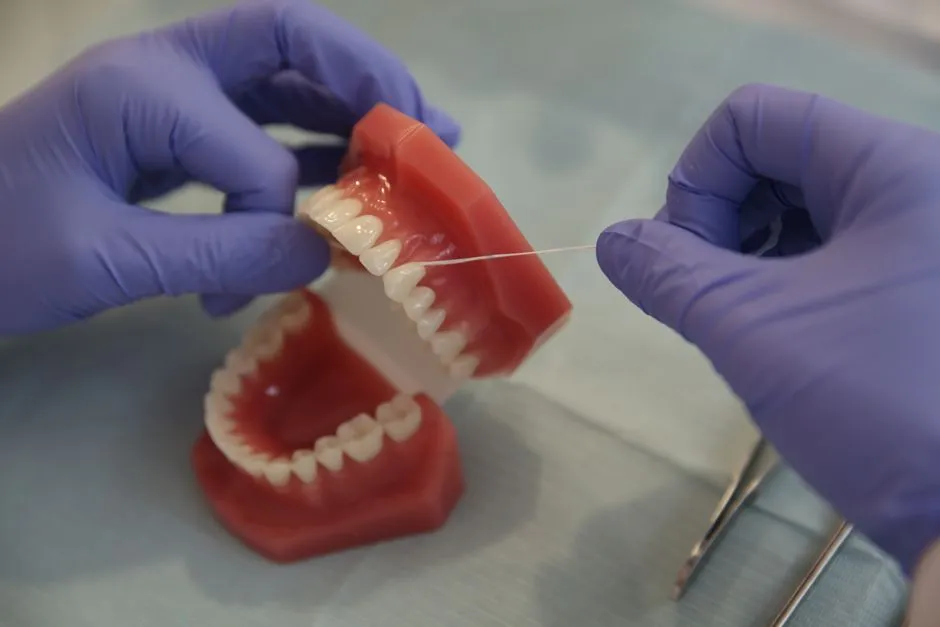
Floss works by contacting the side of each tooth, not by dropping once through the contact. Guide it through gently, curve it into a C against one tooth, move it up and down along that surface, then curve around the neighbouring tooth and repeat. Do not snap it into the gum. The full sequence is shown in our guide to cleaning between teeth safely.
Floss is a reasonable first choice when
- most contacts are too narrow for a brush;
- you can guide the strand around each tooth without pain;
- a dentist or hygienist has shown you how to pass it around existing dental work;
- you prefer a small, inexpensive tool with no charging or water reservoir.
Floss may be a poor practical choice when
- limited hand movement makes wrapping and controlling the strand difficult;
- braces, a fixed retainer, or a bridge blocks a direct path;
- a larger open space does not let the strand contact the whole surface efficiently;
- the floss repeatedly shreds or catches at the same restoration.
Floss picks can simplify grip and one-handed use, but the fixed strand may be harder to wrap closely around each tooth. A holder that enables controlled contact is useful only if it can reach both tooth surfaces without cutting the gum. Do not reuse a disposable strand: the ADA notes that used floss can fray, wear, and redeposit bacteria.
When is an interdental brush the better fit?
An interdental brush has a small bristled head, usually cylindrical or tapered, on a short wire or flexible stem. It cleans by allowing the bristles to contact the facing tooth surfaces as the brush passes through the gap.
It is often the most direct option for visibly open spaces, areas exposed by gum recession, and sites where a dental professional has measured enough room. The ADA notes that brushes come in several sizes to match different spaces. One size does not automatically fit the whole mouth.
Correct sizing feels snug enough for bristle contact but does not require forcing the wire through. If the brush buckles, the wire scrapes, or the gap will not admit the bristles, stop. Choose a smaller size or use floss and ask a dental professional to check the site. Pushing through can injure gum tissue or damage dental work.
Interdental brushes are worth considering when
- spaces are too open for floss to contact efficiently;
- a hygienist has identified areas where a brush fits;
- dexterity makes a handle easier to control than a long strand;
- braces or certain bridge spaces allow access from the side;
- several sizes can be used for different gaps.
For implants, brush construction matters. The ADA states that brushes made for implant cleaning use coated wire to avoid scratching the implant or causing an electrical sensation. Do not assume an exposed metal-wire brush is suitable around every implant restoration. Ask the dentist or hygienist which size and design can contact the intended surfaces without damaging them.
Replace a brush when the bristles are worn, the stem is bent, or the manufacturer’s instructions say to do so. Rinse reusable heads as directed and let them dry. A brush that has become a narrow bundle of flattened bristles no longer has its intended shape.
When is a water flosser the better fit?
A water flosser, also called an oral irrigator, sends a pulsed stream of water around teeth and the gumline. It can remove food and disrupt plaque in places reached by the stream. It does not scrape the tooth with a strand or bristle, so it feels and works differently from mechanical contact cleaning.
The ADA’s patient guidance says water flossers can be an option for people who have difficulty flossing by hand and for people with braces or permanent bridges. Water flossers carrying the ADA Seal have been evaluated for plaque removal and gingivitis reduction. (ADA MouthHealthy)
A water flosser may be practical when
- hand pain, tremor, limited reach, or coordination makes floss difficult;
- brackets, wires, or fixed bridgework create awkward routes;
- a device is easier to use consistently than several threaded passes;
- a dentist or hygienist recommends irrigation for the individual mouth.
Start with the pressure and tip instructions in the device manual. Lean over the sink, close the lips enough to contain spray, and trace the gumline systematically so no area is skipped. High pressure is not a substitute for correct position. Stop if use causes pain or tissue injury.
Whether a water flosser should replace floss or an interdental brush depends on the mouth and the treatment plan. The ADA’s evidence summary reports that evidence for oral irrigators is limited and inconsistent, even though some short-term studies suggest benefit for gingivitis. It also reports that no trials in the cited 2019 Cochrane review assessed decay between teeth. That uncertainty is a reason to avoid a universal replacement claim.
How strong is the evidence comparing the tools?
The answer is less decisive than product advertising suggests.
The ADA summarises a 2019 Cochrane review of home interdental devices used with toothbrushing. Floss or interdental brushes may reduce gingivitis, plaque, or both compared with brushing alone. Interdental brushes may be more effective than floss. Evidence for sticks and oral irrigators was limited or inconsistent. Overall certainty was low to very low, outcomes were mostly short term, and the observed differences may not be clinically important.
Those limits matter. They mean:
- a small average difference in a study does not identify the best device for one person;
- proper technique and actual daily use can outweigh theoretical superiority;
- evidence about short-term plaque or gingivitis cannot be converted into a proven claim about preventing decay or periodontitis;
- professional advice remains important when disease or dental work changes the anatomy.
The practical conclusion is not that interdental cleaning is pointless. It is that the evidence supports adding an appropriate interdental cleaner to brushing without supplying a winner for every mouth.
How do braces, bridges, implants, and retainers change the choice?
Fixed dental work changes access. It also raises the cost of using the wrong shape or excessive force.
Braces
An archwire prevents ordinary floss from moving directly down between teeth. A floss threader or orthodontic floss can carry the strand under the wire; an interdental brush may clean beside brackets; a water flosser may reach around hardware. The orthodontist should show which route cleans each surface without dislodging or bending components.
Fixed bridges
A connected replacement tooth may block floss from entering from the biting surface. Threaded floss, a bridge-specific cleaner, or a water flosser may reach below the artificial tooth, depending on its design. Ask the dentist to demonstrate the path. Do not push sharp objects beneath a bridge.
Implants
The restoration shape and accessible space determine the tool. Use only brushes or floss materials that the dental team considers compatible; coated-wire brushes may be specified. Pain, bleeding, swelling, a change in bite, or movement needs dental review rather than more aggressive cleaning.
Fixed retainers
A bonded wire can block a straight floss pass. A threader, suitable small brush, or water flosser may help, but access differs with the wire and bonding points. The orthodontist or hygienist can map the route.
No device should be forced past hardware. A tool catching or shredding repeatedly at one site may indicate rough dental work, calculus, decay, or simply the wrong tool. The user cannot distinguish those possibilities by feel alone.
Use this selection sequence in the aisle
Ignore feature counts at first. Work through five questions.
- Are the contacts tight or open? Choose floss for tight contacts; consider a correctly sized brush for open spaces.
- Is access blocked? Braces, bridges, implants, or a fixed retainer require device-specific guidance.
- Can your hands control the tool? A handled brush, floss holder, or water flosser may be easier than string.
- Will you use it daily? Setup and cleaning time are part of the decision.
- Has a dental professional advised a specific method? Follow that plan when it addresses gum disease, restorations, surgery, or individual anatomy.
Price does not resolve these questions. Neither does “more powerful.” A basic strand used correctly in a tight contact can be appropriate; an expensive irrigator aimed quickly around the mouth can still miss sites.
The ADA recommends cleaning between teeth once a day and brushing twice a day. Timing is flexible: before or after brushing is acceptable if cleaning is thorough. The full brushing sequence is in How to Brush Your Teeth Correctly.
When should you stop choosing tools and book a dental visit?
Interdental cleaning should not require force or cause ongoing pain. Arrange dental assessment for persistent bleeding, pain, swelling, pus, sores, gum recession that appears to be progressing, a loose tooth, a loose implant or restoration, a change in bite, or floss that consistently tears at one site. Seek urgent dental advice after injury or for rapidly increasing facial swelling, fever with dental symptoms, difficulty swallowing, or difficulty breathing.
A dentist or hygienist can identify which spaces accept floss, which accept a brush, and whether water irrigation should supplement or replace another method in the individual plan. The most accurate answer may be a small map: floss here, brush there, irrigate around this appliance. Teeth are not manufactured with identical gaps. The cleaning plan should not pretend they are.